Education System
Overview of Academic Excellence
Education System in Australia
Australia is renowned for its high-quality education system, offering a wide range of opportunities for both domestic and international students. The Australian education system is diverse and caters to students from kindergarten through to tertiary levels, including higher education, vocational education and training (VET), and beyond. Below is an overview of the key components of the Australian education system, including the Australian Qualifications Framework (AQF), schools, colleges, Registered Training Organisations (RTOs), higher education providers, and universities.
Australian Qualifications Framework (AQF)
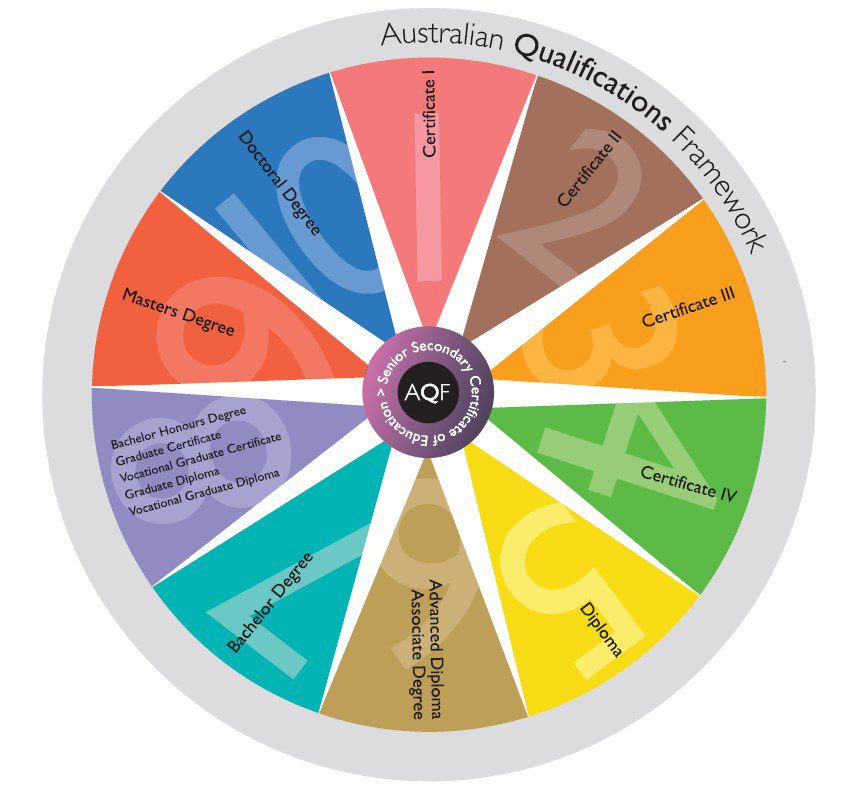
The Australian Qualifications Framework (AQF) is the national policy for regulated qualifications in Australian education and training. It ensures a cohesive system where qualifications from different education sectors, including school, vocational education, and higher education, are aligned and recognized across the country.
For more info visit https://immi.homeaffairs.gov.au/visas/
Levels of the AQF:
The AQF consists of 10 levels, ranging from Certificate I (Level 1) through to a Doctorate (Level 10).
Types of Qualifications:
- Certificates I, II, III, and IV: These are primarily offered by Registered Training Organisations (RTOs) including TAFE and focus on vocational education and skills training.
- Diplomas and Advanced Diplomas: These qualifications also offered by RTOs including TAFE institutes and provide more advanced technical skills. These are also often offered by higher education providers or Universities.
- Bachelor’s Degrees: Typically awarded by universities and higher education providers, these are undergraduate qualifications.
- Postgraduate Qualifications: Including graduate certificates, graduate diplomas, and master’s degrees, as well as doctorates.
The AQF provides a transparent and structured approach to understanding the levels of qualifications and their equivalency across various institutions and sectors.
Education Sectors
Schools (Primary and Secondary Education)
Australia’s school system provides education for children from kindergarten through to the final year of secondary education, typically known as Year 12.
- Primary Education: Primary school in Australia generally begins at the age of 5 or 6 and runs from Kindergarten to Year 6 (or Year 7, depending on the state).
- Secondary Education: Secondary education starts in Year 7 or 8 and continues through Year 12. The completion of Year 12 typically leads to the award of a Senior Secondary Certificate of Education (SSCE), such as the Higher School Certificate (HSC) in New South Wales or the Victorian Certificate of Education (VCE) in Victoria.
Schools sometime offers vocational education generally Certificate I to III and sometime at Certificate IV level.
After completing Year 12, students can enter the workforce, pursue vocational education, or continue on to higher education institutions.
Colleges & TAFE - The RTOs
In Australia, Registered Training Organisations (RTOs) are institutions that provide Vocational Education and Training (VET). There are thousands of private RTOs, commonly referred to as colleges, and government-funded RTOs in every state and territory, known as TAFE (Technical and Further Education) institutions.
TAFE Colleges (Government RTOs): TAFE colleges are government-funded institutions that offer a wide variety of practical, industry-focused qualifications. These institutions provide training across many fields such as trades, business, healthcare, hospitality, and more. TAFE programs are highly regarded and popular among domestic students due to their affordability (with government funding) and reputation for quality education.
Private RTOs (Colleges): Private RTOs, often referred to as colleges, also offer a diverse range of qualifications, from entry-level certificates to advanced diplomas, across industries like technology, health, business, and trades. These colleges are increasingly popular among both domestic and international students because of their flexibility, support services, and high-quality training. Private RTOs provide an option for students seeking tailored learning experiences.
Pathways to University: Some RTOs, including TAFE, offer pathways to university by providing foundational skills that prepare students for university-level studies. These pathway programs are beneficial for students who wish to further their education and transition into a bachelor’s degree program after completing vocational training.
Higher Education Providers in Australia
In Australia, higher education providers encompass a wide range of institutions, including universities and non-university providers that are accredited by the Tertiary Education Quality and Standards Agency (TEQSA). These institutions offer a diverse range of qualifications, from bachelor’s degrees to postgraduate certificates and master’s degrees.
Types of Higher Education Providers:
- Universities: These are the primary institutions offering comprehensive higher education programs.
- Non-University Higher Education Providers: Private institutions and some TAFE colleges that also offer higher education qualifications in fields like business, health, and education.
Both universities and non-university higher education providers in Australia must meet TEQSA’s rigorous standards for academic quality and institutional governance to ensure a high standard of education for all students.
Universities
Australian universities are a key category of higher education providers, recognized globally for their research excellence, high-quality teaching, and academic rigor. As of July 2025, there are 44 universities in Australia, which include both public and private institutions. These universities are spread across major cities and regional areas, offering a wide variety of academic programs and research opportunities. Key Features of Australian Universities:
- Research Excellence: Australian universities are renowned for their contributions to research and innovation, with many ranking among the top global institutions.
- Wide Range of Programs: Universities offer undergraduate, postgraduate, and research degrees across various disciplines, including business, engineering, health sciences, arts, and law.
- Global Recognition: Many Australian universities are consistently ranked among the top universities worldwide, attracting international students for their high academic standards.
- Pathways to Career Success: Australian universities provide students with the skills and qualifications needed to succeed in the global workforce.
Education Sectors - Comparison
| AQF Level | School Sector | VET Sector | Higher Education Sector |
|---|---|---|---|
| 10 | Doctoral degree | ||
| 9 | Masters degree | ||
| 8 | Vocational Graduate Diploma Vocational Graduate Certificate |
Bachelor Honours Graduate Diploma Graduate Certificate |
|
| 7 | Bachelors degree | ||
| 6 | Associate degree Advanced Diploma |
||
| 5 | Diploma | Diploma | |
| 4 | Year 12* | Certificate IV | |
| 3 | Certificate III | Certificate III | |
| 2 | Certificate II | Certificate II | |
| 1 | Certificate I | Certificate I |
* Indicative and informal comparison
CRICOS Provider
A CRICOS (Commonwealth Register of Institutions and Courses for Overseas Students) provider is an institution that is officially registered with the Australian Government to offer courses to international students. These institutions, which include universities, higher education providers, TAFE colleges, private colleges (RTOs), and Schools need to be registered as CRICOS provider to deliver courses to international students where they need to meet strict government standards for quality and compliance under the ESOS (Education Services for Overseas Students) Act.
Enrolling in a CRICOS-registered provider ensures high-quality education, legal protections, and internationally recognized qualifications. As an international student, always verify that your institution and course are CRICOS-registered to ensure they are authorized to provide education and the necessary support services.